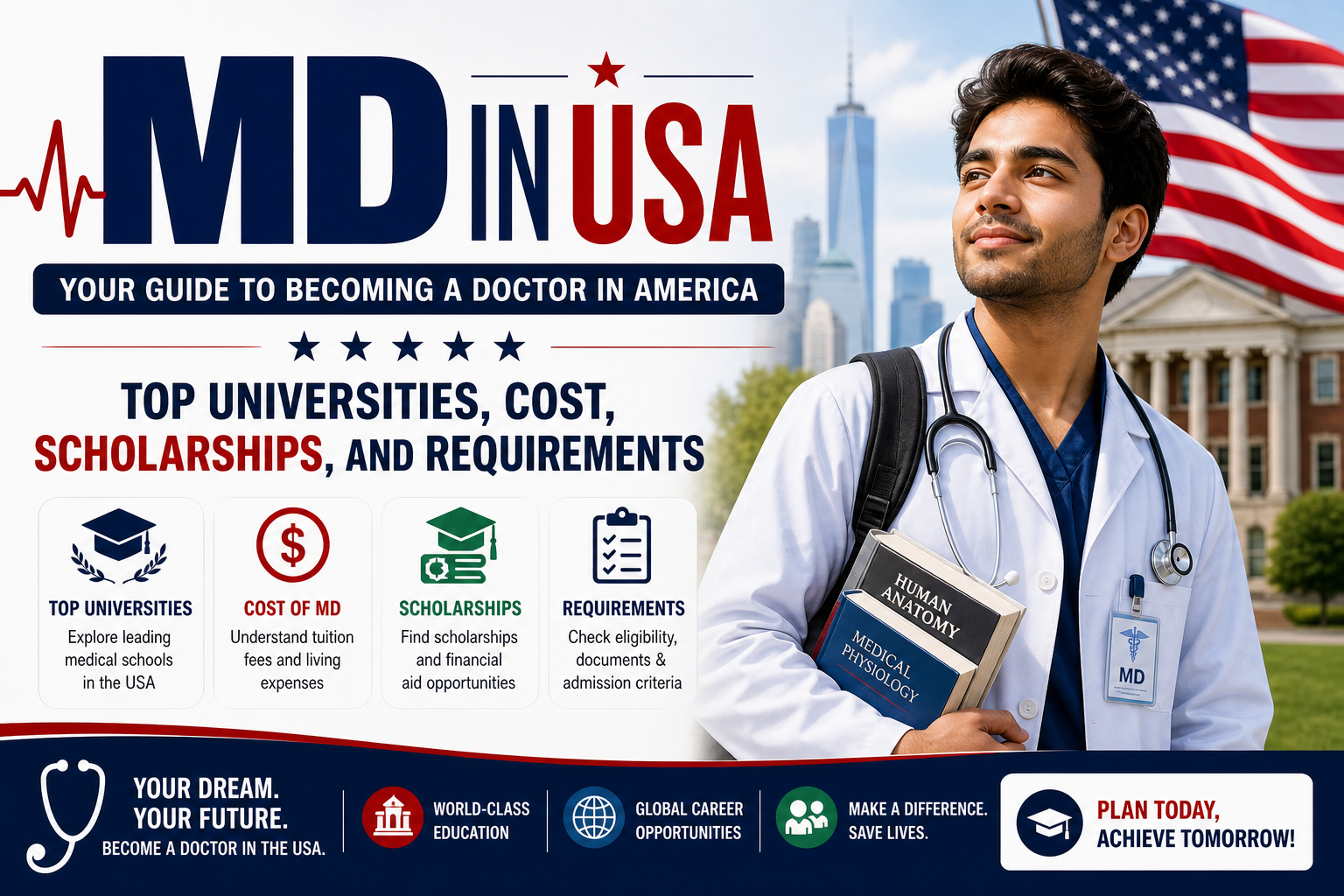
In this section, we will explore what an MD in USA truly means, how the medical education system works, the top universities offering MD in USA programs, and the detailed admission requirements for both domestic and international students.
What Is an MD in USA?
An MD in USA stands for Doctor of Medicine, a professional doctoral degree required to practice medicine in the United States. Unlike many countries where students enter medical school directly after high school, the path to completing an MD in USA typically requires a bachelor’s degree first.
Structure of MD in USA
The journey toward earning an MD in USA usually follows this pathway:
-
Undergraduate Degree (Pre-Med Track) – 4 Years
-
Medical School (MD Program) – 4 Years
-
Residency Training – 3 to 7 Years (depending on specialty)
This means completing an MD in USA is a long-term commitment that can take 11 to 15 years, depending on specialization.
Difference Between MD in USA and MBBS
In many countries, students earn an MBBS degree directly after high school. However, the MD in USA requires prior undergraduate education. Additionally:
-
MD in USA emphasizes research, clinical exposure, and standardized licensing exams.
-
The USMLE (United States Medical Licensing Examination) is mandatory after completing MD in USA.
-
The MD in USA degree is globally recognized and highly respected.
Because of its rigorous training structure, an MD in USA is considered one of the most competitive medical qualifications worldwide.
Why Study MD in USA?
There are several compelling reasons why students choose to pursue an MD in USA.
1. World-Class Medical Education
Medical schools offering MD in USA programs consistently rank among the top globally. Institutions emphasize evidence-based medicine, innovation, and hands-on patient care.
2. Advanced Research Opportunities
Students pursuing MD in USA gain access to groundbreaking research in fields like:
-
Oncology
-
Neurology
-
Cardiology
-
Artificial intelligence in healthcare
-
Genomics and biotechnology
The opportunity to participate in clinical research enhances the value of an MD in USA degree.
3. High Salary Potential
Doctors who complete MD in USA programs often earn significantly higher salaries compared to many other countries. While compensation varies by specialty, physicians in the U.S. are among the highest-paid professionals globally.
4. Global Recognition
An MD in USA is widely respected. Graduates can pursue fellowships, academic positions, and research opportunities internationally.
5. Advanced Healthcare Infrastructure
Studying MD in USA exposes students to modern hospitals, advanced diagnostic technologies, and diverse patient populations.
Top Universities Offering MD in USA
Choosing the right institution is critical when pursuing an MD in USA. Below are some of the top medical schools known for excellence in MD in USA programs.
1. Harvard Medical School
Harvard is frequently ranked as one of the best institutions for MD in USA. It is known for research excellence, innovation, and strong hospital affiliations.
2. Johns Hopkins University School of Medicine
Johns Hopkins is globally recognized for its contributions to medical research and clinical training. An MD in USA from Johns Hopkins carries strong academic prestige.
3. Stanford University School of Medicine
Stanford integrates technology and medicine, making it ideal for students interested in medical innovation and biotechnology within their MD in USA journey.
4. University of California, San Francisco (UCSF)
UCSF is known for patient-centered training and cutting-edge biomedical research.
5. University of Pennsylvania Perelman School of Medicine
This Ivy League institution offers a comprehensive MD in USA program with strong research and clinical exposure.
6. Mayo Clinic Alix School of Medicine
Mayo Clinic provides strong clinical immersion, which enhances the practical training experience during MD in USA studies.
Public vs Private Schools for MD in USA
When choosing where to pursue an MD in USA, students must consider:
-
Tuition differences
-
Residency status (in-state vs out-of-state tuition)
-
Research opportunities
-
Clinical training facilities
Public medical schools may offer lower tuition for residents, while private schools may have larger endowments and scholarship funds for MD in USA students.
Admission Requirements for MD in USA
Gaining admission into an MD in USA program is highly competitive. Medical schools evaluate applicants holistically.
1. Bachelor’s Degree Requirement
Before applying for an MD in USA, students must complete a bachelor’s degree, usually in:
-
Biology
-
Chemistry
-
Biochemistry
-
Neuroscience
-
Pre-medical studies
Although any major is acceptable, students must complete required science prerequisites.
2. Required Coursework for MD in USA
Most MD in USA programs require the following courses:
-
General Biology (with lab)
-
General Chemistry (with lab)
-
Organic Chemistry
-
Physics
-
Biochemistry
-
English
-
Mathematics or Statistics
Strong academic performance in these courses is critical for MD in USA admission.
3. GPA Requirements
Competitive MD in USA programs often expect:
-
Overall GPA above 3.5
-
Strong science GPA
Top-tier institutions offering MD in USA may have even higher academic expectations.
4. MCAT (Medical College Admission Test)
The MCAT is a standardized exam required for admission to MD in USA programs. It assesses:
-
Biological sciences
-
Chemical and physical foundations
-
Psychological and social foundations
-
Critical analysis and reasoning skills
A high MCAT score significantly improves chances of securing admission into an MD in USA program.
5. Letters of Recommendation
Applicants to MD in USA programs must submit strong letters of recommendation from:
-
Professors
-
Research supervisors
-
Physicians
Strong endorsements can strengthen an MD in USA application.
6. Clinical Experience
Medical schools expect applicants pursuing MD in USA to demonstrate:
-
Volunteer work in healthcare settings
-
Shadowing physicians
-
Research experience
-
Community service
These experiences show commitment to the medical profession.
7. Personal Statement
A compelling personal statement is essential for MD in USA applications. Students must clearly explain:
-
Why they want to pursue medicine
-
Why they chose MD in USA
-
Their career goals
-
Their commitment to patient care
Authenticity and clarity are crucial.
Requirements for International Students Pursuing MD in USA
International students face additional steps when applying for MD in USA.
1. Credential Evaluation
International transcripts must be evaluated to ensure equivalency to U.S. bachelor’s degrees.
2. English Proficiency
Non-native English speakers may need TOEFL or IELTS scores when applying for MD in USA.
3. Visa Requirements
Students admitted to MD in USA programs typically require an F-1 student visa.
4. Financial Documentation
International applicants must demonstrate the ability to cover tuition and living expenses during MD in USA studies.
Because MD in USA programs are highly competitive, international students often need strong academic profiles and exceptional MCAT scores.
How Competitive Is MD in USA Admission?
Admission to MD in USA programs is extremely competitive. Acceptance rates at top schools can be below 5%. Factors that increase competitiveness include:
-
Limited seats
-
High number of applicants
-
Strong academic benchmarks
-
Holistic review process
To improve chances of admission for MD in USA, applicants should:
-
Maintain high GPA
-
Score well on MCAT
-
Gain meaningful clinical exposure
-
Demonstrate leadership skills
-
Engage in research
Duration and Academic Structure of MD in USA
The MD in USA program typically spans four years:
Years 1–2: Pre-Clinical Training
-
Classroom-based learning
-
Anatomy, physiology, pathology
-
Medical ethics
-
Simulation labs
Years 3–4: Clinical Rotations
-
Internal medicine
-
Surgery
-
Pediatrics
-
Psychiatry
-
Obstetrics and gynecology
Clinical rotations are critical components of MD in USA education because they provide real patient care experience.
Pursuing an MD in USA is a major academic and financial commitment. While Section 1 covered universities and admission requirements, this section focuses on the financial investment required for an MD in USA, scholarship opportunities, residency and licensing pathways, and long-term job prospects after completing an MD in USA.
Understanding the full financial and career landscape of an MD in USA is essential before beginning the journey. From tuition fees to physician salaries, every stage plays a role in determining whether pursuing an MD in USA aligns with your professional goals.
Cost of Studying MD in USA
One of the most important factors students consider when planning for an MD in USA is the total cost. Medical education in the United States is known for being expensive, but it also offers high earning potential after graduation.
1. Tuition Fees for MD in USA
The tuition cost of an MD in USA varies depending on whether the institution is public or private.
-
Public Medical Schools (In-State Students): Lower tuition rates for residents.
-
Public Medical Schools (Out-of-State Students): Higher tuition.
-
Private Medical Schools: Typically higher tuition regardless of residency.
On average, annual tuition for an MD in USA can range from moderate to very high depending on the institution. Over four years, tuition alone can represent a significant investment.
Private institutions offering MD in USA programs generally have higher tuition but may also provide more financial aid options.
2. Living Expenses During MD in USA
In addition to tuition, students pursuing an MD in USA must consider:
-
Housing costs
-
Food and groceries
-
Health insurance
-
Transportation
-
Books and medical equipment
-
Personal expenses
Living costs vary depending on the city. For example, pursuing an MD in USA in cities like New York or San Francisco may involve higher living expenses compared to smaller cities.
3. Additional Expenses for MD in USA
Students should also budget for:
-
MCAT exam fees
-
Application fees
-
USMLE exam registration
-
Residency application costs
-
Travel for interviews
These additional costs add to the overall financial commitment required for an MD in USA.
Total Estimated Cost of MD in USA
When combining tuition and living expenses, the total cost of completing an MD in USA over four years can be substantial. However, many students view this as a long-term investment due to the strong earning potential after completing residency.
Because an MD in USA leads to high-income career paths, many graduates manage educational debt through structured repayment plans once they begin practicing medicine.
Scholarships and Financial Aid for MD in USA
Despite the high cost of an MD in USA, several financial aid options are available.
1. Merit-Based Scholarships
Some institutions offering MD in USA provide merit-based scholarships based on:
-
Academic excellence
-
MCAT scores
-
Research achievements
-
Leadership experience
Highly competitive applicants may receive partial or full tuition support for their MD in USA studies.
2. Need-Based Financial Aid
Many medical schools provide need-based financial aid packages. For U.S. citizens pursuing an MD in USA, federal student loans are widely available.
Need-based grants can significantly reduce the financial burden of completing an MD in USA.
3. Scholarships for International Students
International students pursuing an MD in USA have fewer funding options, but some institutions offer limited scholarships.
Private foundations and research assistantships may also provide support. However, securing funding for MD in USA as an international student can be competitive.
4. Service-Based Scholarship Programs
Certain programs provide financial support for MD in USA students in exchange for service commitments, such as:
-
Working in underserved communities
-
Serving in public health roles
-
Military medical service
These programs can significantly reduce the cost of earning an MD in USA.
Residency After MD in USA
Completing an MD in USA does not automatically allow graduates to practice independently. After medical school, graduates must complete residency training.
What Is Residency?
Residency is supervised clinical training in a chosen specialty. The length of residency after MD in USA depends on the field:
-
Internal Medicine: 3 years
-
Pediatrics: 3 years
-
Surgery: 5 years
-
Neurosurgery: 7 years
Residency is a mandatory step after earning an MD in USA.
USMLE and Licensing After MD in USA
To practice medicine after completing an MD in USA, graduates must pass the United States Medical Licensing Examination (USMLE).
USMLE Steps
-
Step 1: Basic medical sciences
-
Step 2: Clinical knowledge and skills
-
Step 3: Clinical management
Passing these exams is required for medical licensure after MD in USA.
Strong USMLE performance is also critical for securing competitive residency placements after MD in USA.
Residency Match Process
Graduates of MD in USA programs apply for residency through the National Resident Matching Program (NRMP).
The residency match process considers:
-
USMLE scores
-
Medical school performance
-
Letters of recommendation
-
Interview performance
Matching into a competitive specialty after MD in USA can significantly influence future income and career direction.
Job Prospects After MD in USA
One of the primary motivations for pursuing an MD in USA is strong career prospects.
1. Clinical Practice
Graduates who complete MD in USA and residency can practice as:
-
General physicians
-
Surgeons
-
Specialists (cardiology, dermatology, oncology, etc.)
Specialization often increases earning potential after MD in USA.
2. Academic Medicine
Some MD in USA graduates pursue careers in:
-
Medical research
-
Teaching
-
Clinical trials
-
Healthcare policy
Academic positions offer opportunities for innovation and leadership.
3. Private Practice
After completing MD in USA and residency, physicians may establish private practices, offering independence and income growth potential.
4. Hospital Employment
Many MD in USA graduates work in:
-
Public hospitals
-
Private hospitals
-
Specialized clinics
-
Urgent care centers
Hospital-based employment often offers structured salary packages and benefits.
Salary Potential After MD in USA
Salaries after completing MD in USA vary by specialty, experience, and location.
Generally, physicians who complete MD in USA and residency earn competitive salaries. Some specialties such as surgery and cardiology may offer higher compensation compared to primary care roles.
While medical school requires financial investment, long-term earnings after MD in USA often offset the initial cost.
Work Visa and Opportunities for International Graduates
International students who complete MD in USA may require visa sponsorship during residency or employment.
Common visa pathways include:
-
J-1 Visa (Exchange Visitor Program)
-
H-1B Visa (Specialty Occupation)
Understanding immigration policies is important for international students pursuing MD in USA.
Advantages of Completing MD in USA
There are many advantages to earning an MD in USA:
-
Global recognition
-
Access to advanced healthcare systems
-
Strong earning potential
-
Research and innovation opportunities
-
Career flexibility
The MD in USA credential opens doors to leadership roles within healthcare systems worldwide.
Challenges of MD in USA
While rewarding, pursuing an MD in USA also involves challenges:
-
High tuition costs
-
Competitive admissions
-
Intense academic workload
-
Lengthy training period
Students must prepare mentally, academically, and financially before committing to MD in USA.
Is MD in USA Worth It?
For many students, the answer is yes. Despite the high cost and competitive process, an MD in USA offers:
-
Long-term financial stability
-
Professional prestige
-
Diverse specialization options
-
Global career mobility
Careful financial planning, scholarship research, and strong academic preparation can make the journey toward MD in USA more manageable.
Final Conclusion
An MD in USA represents one of the most respected and rewarding medical qualifications globally. From tuition and scholarships to residency and high-paying job prospects, every stage of MD in USA requires commitment and strategic planning.
While the financial investment can be significant, the long-term career opportunities and earning potential after completing MD in USA make it a worthwhile goal for many aspiring physicians.
By understanding the cost, funding options, residency requirements, licensing exams, and job outlook, students can confidently plan their journey toward earning an MD in USA and building a successful medical career.